A note, peer to peer

LX Hostel — Observations & Suggestions

Notes from one month staying as a guest. I run a clothing business, not a consultancy — this is sent peer-to-peer with respect, not as a pitch. Take what's useful, ignore what isn't.

The thread running through all of this

Most of what's below looks like 14 different problems. It isn't. It's one problem wearing different costumes.

All your operational knowledge lives in people's heads. Katia & Patrice carry most of it. Katia, when she's here, things work. When she's not, the system grinds. The new Argentinian colleague being trained right now — over three sessions I've watched her ask hundreds of questions, and none of the answers are being captured anywhere. The next new hire will ask the same hundreds of questions. The volunteer arriving next month will too. And the guy from the bar counting paper receipts at the table — he's doing the same thing: being used as a system, because the actual system doesn't exist.

The single biggest unrecognised cost in the hostel is this: you pay to relearn the same things, in person, every time someone joins. And if she ever moves on, the cost isn't a few weeks of re-explaining — it's that the organisational memory walks out the door with her.

The thesis of everything below:

capture the knowledge once, deploy it forever.

Once you have that habit, every other improvement on this list — guest FAQs, volunteer onboarding, receipt entry — is the same fix applied to a different surface.

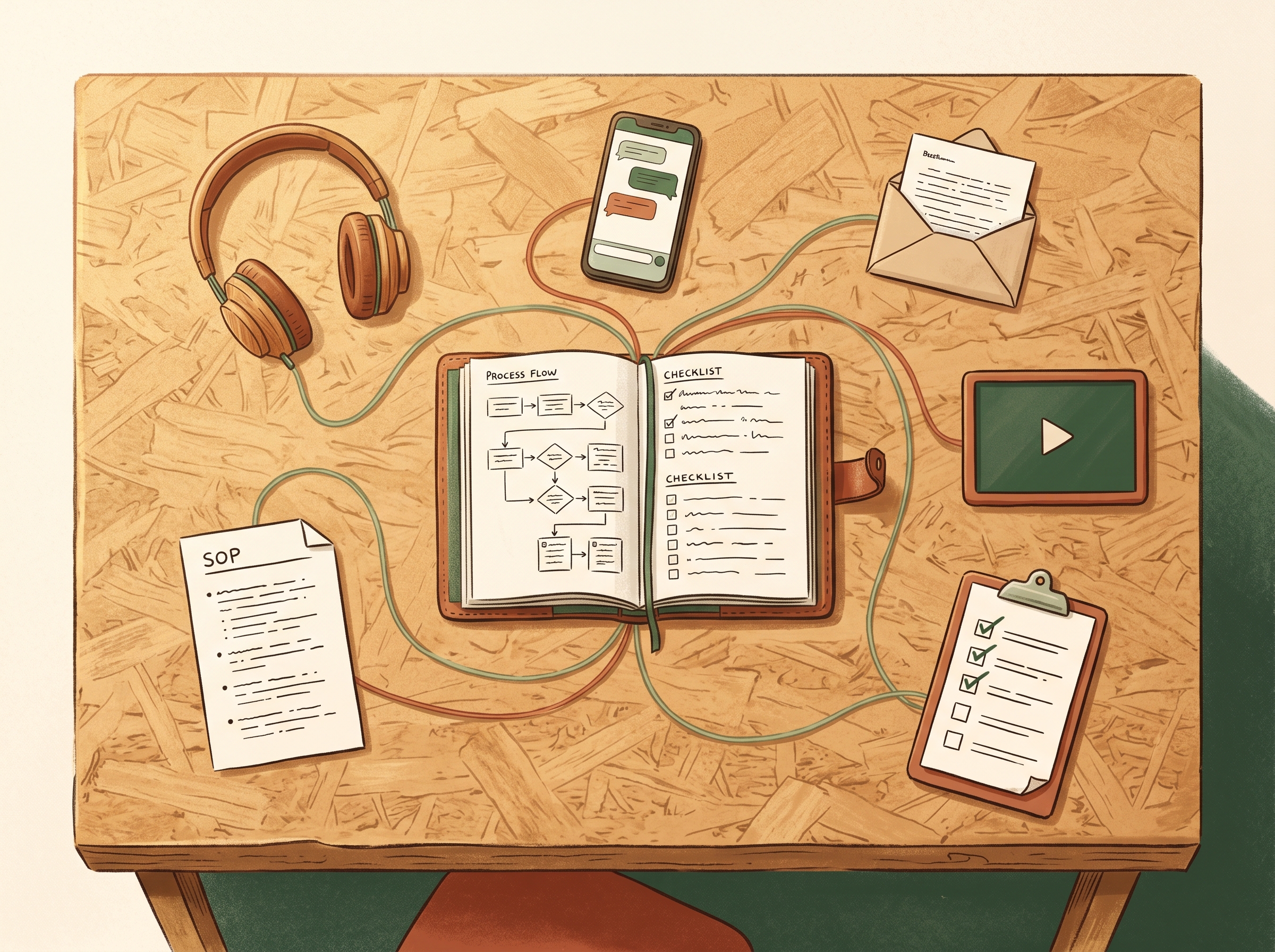
An overhead view of a worn wooden desk. At the centre, an open notebook showing a process flow diagram and a checklist — the master operations manual. Arranged around it: over-ear headphones (audiobook), a smartphone showing a chat helper, a printed letter in an envelope (pre-arrival pack), a small screen with a play icon (training video), a clipboard with a ticked checklist (quiz), and a printed SOP page. All connected back to the central notebook by thin sage-green and terracotta threads.
One source. Many surfaces.
Tier 1

The big lever

knowledge & systems
01

Training is the most expensive process in the hostel

Problem. I watched the new colleague's training across three sessions. The trainer is excellent — the process is the disaster. ~90% of the questions are standard, repeatable, FAQ-shaped. None of the answers are captured. Every new hire restarts from zero. By a wide margin this is the costliest, most-repeated, most-wasted process in the building.

The key-person risk. Most of this works because the senior person doing the training is patient enough to handle 600 questions without snapping. That's exceptional, and it's also a single point of failure. If she leaves — for a better offer, a holiday, a burnout — there isn't a second person with both the patience and the organisational knowledge to run the playbook. The hostel doesn't just lose a manager; it loses its operating manual.

What good looks like — a persistent training brain.

  • Every recurring task has a written guide anyone can read.
  • The visual ones have short video walkthroughs.
  • New staff sit a quiz before they're cleared for unsupervised shifts. Score on file.
  • An always-on "how do I…?" helper for live questions during a shift, so nobody pulls the senior manager away.
  • Audiobook of the operations — created in a storytelling narrative format, sourced off all of the FAQs and SOPs. New staff (and volunteers) listen to it as a podcast before they start their contract, on the plane, on the walk in. Far stickier than reading SOPs cold; turns dead time into onboarding.
  • Every time anyone answers something that isn't in the brain, it gets added. The corpus compounds. Year 3's training cost is a fraction of year 1's.

And train remotely, before arrival. This is the unlock. New permanent staff and every volunteer get the materials the moment they're hired or accepted — guides, videos, audiobook, quiz. Their score lands in your inbox before they get on a plane. Refreshers run quarterly, asynchronously, with zero senior-staff time.

Why it matters. Highest-leverage change on this entire list. De-risks your key people, compresses training time by 80%+, makes every future hire cheaper than the last, and turns the hostel from a person-dependent business into a system-dependent one. Every other point below is a symptom of not having this in place.

Effort · Bigger build, but stages cleanly — written guides and audiobook can be in place inside a month
02

Receipt counting at the table — same disease, different costume

Problem. Every 2–3 days, the guy from the bar comes downstairs, sits at the lobby table, and spends 2–3 hours counting paper receipts and manually typing numbers into an Excel file. He's a lovely guy and not a power-user — the friction is visible. That's 25–35 hours a month of a human being used as a scanner.

What good looks like — two angles.

  • Catch it upstream. Each receipt is captured digitally as it's generated at the bar. By end of shift, the data is already structured — the table session disappears entirely.
  • Or read it later. The paper receipts get read automatically and the numbers land in the spreadsheet on their own. The 2–3 hours becomes 10 minutes of reviewing the output.

Why it matters. Same problem as the training one in disguise: a person is being used as the system. Replace the person with the system, and the person does something that actually grows the business.

Effort · Small lift either way. Upstream capture is almost free
03

Always-on guest Q&A — kill the FAQ tax

Problem. Roughly 80% of guest questions are the same 20 questions — wifi, breakfast, taxis, sights, washing, late arrival, towels, locker codes. Each one steals staff attention from the 20% of questions that genuinely need a human.

What good looks like. Guests can ask any question — and get a direct, instant answer, around the clock, in any language, without involving staff. Only the genuinely novel questions reach a human. Every question asked is also logged, so you finally see what guests actually wonder about.

Why it matters. Reception becomes a calm space, not a help desk.

Effort · Medium lift
04

Volunteer onboarding — automate it

Problem. Volunteers consume permanent-staff time in three phases: arrival, training week, and ongoing questions for the first 7 days. Most of that time falls on the senior manager. Often the volunteer's contribution is below the cost to train them.

What good looks like. Same approach as #1, applied earlier. Volunteers go through the guides, videos, audiobook, and quiz before they arrive — not after. Their score is on your desk before they get on a plane. The ongoing-question helper covers them through their first shifts. Ramp drops from a week of senior-staff attention to half a day.

Why it matters. Volunteers stop being a tax on senior-staff time and start being net-positive labour from day one. Bad fits are caught at the quiz stage, before they cost you a flight subsidy and a bed.

Effort · Small lift once #1 exists — it reuses the same material
Tier 2

Strategic calls

what to stop, what to measure
05

Volunteer model — honest cost audit

Problem. Volunteers look like "free labour" on the headline cost. The real cost includes training time (#4), nighttime noise (heels and locker-banging after 1am), rule-breaking, and the 1-star reviews from paying guests who got woken up. A single bad review can wipe out weeks of "free" labour.

What good looks like. Quantify it. For one quarter, log volunteer hours given against (training hours consumed + nights with noise complaints + reviews mentioning noise/behaviour). If the ledger is negative — and it likely is — phase volunteers out, or restrict them to a wing separate from paying guests with a hard nighttime curfew.

Why it matters. This is a strategic call about who the hostel is for: paying guests buying sleep, or volunteers paying with labour. Right now the two are colliding, and the paying guest is losing.

Effort · Small lift — it's a measurement exercise, then a decision
06

Nighttime rules — the enforcement gap nobody is measuring

Problem. No staff on premises at night, so rules aren't enforced. The hostel believes it isn't a problem because no one is measuring it — but it happens multiple nights a week: loud returns, packing at 5am, alarms going off, conversations in the dorms.

What good looks like — two parts.

  • Measure. One extra question on the post-stay feedback (#9): "Were you woken or disturbed at night? When?" You'll have the truth in 30 days.
  • Enforce. A way to monitor dorm noise levels at night, with an automatic warning sent to the offending dorm. A hotline number on every bunk for live complaints.

Why it matters. Sleep is the product. Everything else — breakfast, vibe, location — is downstream of whether guests slept.

Effort · Small lift to measure. Medium lift to enforce
Tier 3

Self-service for guests

remove the small frictions
07

Pre-arrival Welcome Pack — fix the broken first impression

Problem. Arrival is the single most damaged moment in the guest journey, and it's all caused by missing information that should have been sent before they arrived.

  • Roughly 1 in 2 guests don't know check-in is 3pm. They show up at 11am with luggage, get told to wait outside, end up dumping bags in the same corner everyone else uses, and start the stay frustrated. None of this is in the booking confirmation or any follow-up — it's nowhere.
  • Then every one of them asks the same handful of questions at the desk. Washing machine. Check-out time. Early check-out. Breakfast hours. Where things are.
  • By the 30th time staff hear those questions in a shift, they're tired and short. Not their fault — it's an impossible setup. But that shortness becomes the guest's first impression of the hostel. That's how 5-stars become 4s, and 4s become 3s.

What good looks like — a single, branded "Welcome to LX Hostel" pack sent 24–48h before check-in. Contains:

  • Check-in time is 3pm. What to do if you arrive earlier — exact bag-storage location, photos, directions to a coffee nearby.
  • The FAQ pack. Washing, check-out, early check-out, breakfast hours, wifi, lockers, late arrival, neighbourhood basics.
  • The 90-second welcome video (#8).
  • Forms and ID completed in advance, so check-in is key-in-hand in under a minute.

One source, three surfaces. The same content lives in (a) the pre-arrival pack, (b) the website FAQ page, (c) the always-on Q&A helper (#3). Write it once, deploy three times, update once. This is the master thesis applied to the guest side.

Why it matters. Two wins, in order of importance.

  • The guest experience. When staff aren't being asked the same six questions for the 40th time, they're not exhausted — and every interaction at reception is genuinely warm again. That is what gets you 5-star reviews. The current setup is silently costing you reviews you don't know you're losing.
  • Staff time at the desk collapses by ~70%. Only the genuine edge cases need a human.
Effort · Small to Medium lift. Email and FAQ page are a weekend; the form-and-ID flow is the bigger piece
08

Digital tour & intro video

Problem. Staff repeat the same tour ("kitchen here, lockers work like this, breakfast 8–10") thirty-plus times a day.

What good looks like. A 90-second self-guided tour video. Sent in the pre-arrival pack (#7), and a QR at reception for walk-ups. Covers layout, lockers, breakfast, wifi, washing, rules. Same information, perfectly consistent, in any language.

Why it matters. Removes a recurring drain and makes the experience feel more professional, not less.

Effort · Small lift
09

Anonymous QR-code feedback

Problem. You only hear from the small fraction of guests who post a public review. The quiet majority of pain points — temperature, noise, broken hardware — never reach you, or reach you too late to act.

What good looks like. QR codes on bunk frames, common-area walls, and bathroom doors → one-tap anonymous form. Two sliders (cleanliness, noise) + free text. Aggregates into a weekly summary you can read in 5 minutes.

Why it matters. Continuous signal, zero staff time, catches problems before they become 1-star reviews. Also: the answer to #6's measurement problem.

Effort · Small lift
10

Washing-machine queue

Problem. Constant interruptions — "is it free?", "whose stuff is in there?", "how does it work?" Staff become washing concierges. Also causes guest-on-guest friction.

What good looks like. Guests see what's free and book a 90-minute slot from their phone. Their name is auto-attached. They get a ping when the cycle ends. A printed quick-start card on the wall covers the basics.

Why it matters. Removes a recurring staff drain and a recurring source of guest frustration.

Effort · Small to Medium lift
11

Saturday bottleneck — stair queue

Problem. Saturdays back up. Guests queue on the stairs to get upstairs. Bad first impression, bad photo for any review.

What good looks like. Guests pre-book a 5-minute slot for whatever the bottleneck is, during pre-check-in (#7) or via the Q&A helper (#3). No-shows release the slot automatically.

Why it matters. Smooths the peak, kills the queue, signals professionalism.

Effort · Small lift
Tier 4

Process basics & quick wins

the small stuff worth doing once
12

Dead hours in the staff schedule

Problem. Predictable dead zones — Saturday 12–2pm being the obvious one — where staff are paid to be present and idle.

What good looks like. Map a typical week, identify the dead bands, then either (a) thin the cover during those hours, or (b) bank that time for high-leverage recurring work: drafting SOPs (#1), filming videos (#8), inventory audits (#13).

Why it matters. Same payroll → more output. Or smaller payroll → same output.

Effort · Small lift — it's a calendar exercise
13

Stock-taking & deliveries — kill the chaos with a kanban + 2-bin system

Problem. Stock-taking quietly exists in many places — cleaning supplies, toiletries, kitchen, the bar — and all of it runs on staff memory. Worse, the incoming deliveries every other day are a small disaster. They arrive at the lobby, the orders are often incorrect, and reception staff have to drop everything to fact-check the invoice line-by-line — typically a 30-minute job. Meanwhile guests are queuing at the desk for someone to be free. Bad guest experience, expensive staff time, and the supplier never gets called out because nobody is tracking the error rate.

What good looks like — a 2-bin + kanban system across every stock category.

  • 2-bin per item. Each item has two bins. When bin 1 empties, that's the visible reorder trigger; bin 2 covers you until restock. No counting, no spreadsheet, no "did anyone order more?" loops.
  • A small kanban board in the supply room — one card per item showing par level, current bin state, supplier, last order date. A glance tells you the entire stock picture.
  • Pre-counted delivery sheets. Each delivery arrives with an expected sheet (auto-printed from the kanban — "today we're expecting 6 of X, 12 of Y"). Whoever receives it ticks the sheet in 5 minutes instead of 30. The supplier sees you're now checking, and their error rate quietly drops.
  • Anyone — a brand-new volunteer — can run inventory and receive a delivery with zero training. That's the whole point.
  • A 4-minute primer on the 2-bin method (this is a known industrial methodology, not something I'm inventing): How the 2-bin system works.

Why it matters. Three wins at once.

  • Reception stops being the receiving department. Deliveries become a 5-minute job anyone can do, freeing the desk for guests who are currently queuing while staff verify invoices.
  • Wrong deliveries get caught immediately — not three days later when you realise the soap shipment was short.
  • Stockouts stop happening. The second bin is your buffer, always.
Effort · Small lift — mostly bins, printed cards, and a one-off "list every item" pass to set par levels
14

Permanent water filtration

Problem. Staff physically refill Brita jugs multiple times a day — pure waste.

What good looks like. A plumbed-in filtered water station (under-counter or wall-mount). Refills itself, forever.

Why it matters. Pays back in staff time within months, then forever.

Effort · Small lift — one-time install

How it all connects

The diagram, if we drew one, would have the Knowledge Brain in the middle — the guides + videos + audiobook + quiz + always-on helper from #1. Everything else plugs into it:

Build the brain once. Everything else gets cheaper, more consistent, and less dependent on any single person — including, eventually, you.